
Newsroom
News & Press
NEWS [Expert Contribution] Indecent Act by Compulsion: How the Times Change…
Post information

Content
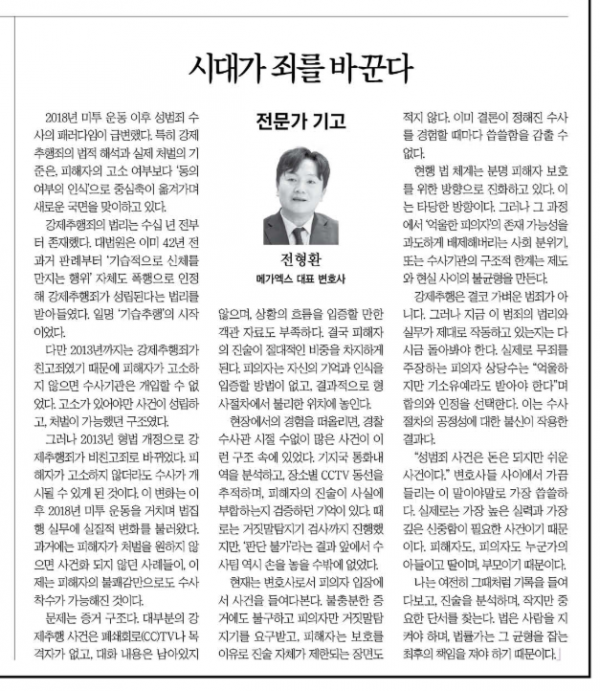
Since the #MeToo movement in 2018, the paradigm of sex crime investigations has changed rapidly. In particular, the legal interpretation and practical standards for punishment in cases of indecent act by compulsion have entered a new phase, with the focus shifting from whether the victim filed a complaint to whether the accused recognized the absence of consent.
The legal doctrine surrounding indecent act by compulsion has existed for decades. As early as 42 years ago, the Supreme Court accepted the principle that the act of suddenly touching another person’s body itself may constitute assault, thereby establishing the crime of indecent act by compulsion. This marked the beginning of what is commonly referred to as “surprise indecent assault.”
Until 2013, however, indecent act by compulsion was an offense that required a complaint from the victim. If the victim did not file a complaint, investigative authorities could not intervene. The case could only proceed, and punishment could only be imposed, when a complaint was filed.
With the 2013 amendment to the Criminal Act, however, indecent act by compulsion became an offense that no longer requires a victim’s complaint. Investigations could be launched even without a complaint from the victim. This change led to a substantial shift in law enforcement practice after the #MeToo movement in 2018. Cases that would previously not have become criminal matters if the victim did not wish to seek punishment can now lead to the opening of an investigation based solely on the victim’s sense of discomfort.
The problem lies in the structure of evidence. Most indecent act by compulsion cases lack closed-circuit television footage or witnesses. There are often no remaining records of the conversation, and objective materials that could prove the flow of events are also insufficient. As a result, the victim’s statement comes to carry decisive weight. The suspect has no way to prove his own memory or perception, and consequently finds himself placed at a disadvantage in the criminal procedure.
Looking back on my experience in the field, countless cases I handled as a police investigator involved this very structure. I remember analyzing base station call records, tracking movements through CCTV footage at each location, and verifying whether the victim’s statement matched the facts. At times, we even conducted polygraph examinations, but when the result came back as “inconclusive,” the investigation team had no choice but to stop there.
Now, as an attorney, I review cases from the perspective of the accused. There are not a few instances where, despite insufficient evidence, only the suspect is asked to undergo a polygraph examination, while the victim’s statement itself is limited on the grounds of protection. Each time I encounter an investigation where the conclusion seems to have already been decided, I cannot help but feel a sense of bitterness.
The current legal system is clearly evolving in the direction of protecting victims. This is a valid and necessary direction. However, in the process, a social atmosphere that excessively excludes the possibility of an “unjustly accused suspect,” together with the structural limitations of investigative agencies, creates an imbalance between the system and reality.
Indecent act by compulsion is by no means a minor crime. Yet we must once again examine whether the legal doctrine and practice surrounding this crime are functioning properly. In reality, many suspects who claim innocence choose settlement and acknowledgment, saying, “I feel wronged, but I should at least receive a suspended indictment.” This is the result of distrust in the fairness of the investigative process.
“Sex crime cases are profitable, but easy.” This phrase, sometimes heard among attorneys, is the most bitter of all. In reality, these are cases that require the highest level of skill and the deepest caution. Both victims and suspects are someone’s sons and daughters, and someone’s parents.
I still review records, analyze statements, and search for small but important clues, just as I did then. The law must protect people, and legal professionals must bear the ultimate responsibility of maintaining that balance.
Source: Aju Business Daily, Reporter Kwon Kyu-hong, “[Expert Contribution] Indecent Act by Compulsion: How the Times Change the Crime,” June 17, 2025.
Full article available at the original URL.
Related links
- PreviousPositioning Itself as a “Go-To Legal Destination,” Mega-X Introduces Fixed Fees for Criminal Cases 26.06.29
- Next[Legal Talk] Mega-X Managing Partner Chon Hyeong Hwan: “We Will Become a Practical Legal Hub Connecting Korea and Southeast Asia” 26.06.29
Comments
There are no comments yet.